SolidWorks: Online Licensing Troubleshooting

Troubleshooting SolidWorks Online Licensing

New to SolidWorks 2018, Online Licensing offers users the flexibility of accessing SolidWorks licenses through online MySolidWorks profiles. An administrative portal on MySolidWorks gives designated users the ability to assign seats of SolidWorks to members of their team. While this option is a huge step forward, in comparison to machine activation/deactivation using the modify install, implementation of online licensing companywide has uncovered many issues that have yet to be solved by SolidWorks upon their first release. This blog will hopefully ease a headache when running into errors, while trying to convert workstations over to online licensing for daily use. For help with using the administrative portal, switching serial numbers to online licensing, and for general procedural directions using online profiles in SolidWorks please reference the link at the end of this blog.

Activation issues

After following the procedure to make the switch from machine to online activation in the administrative portal on MySolidWorks, SolidWorks will require two startups before recognizing that online licensing is attached to the serial number. The first startup, after going through the standard machine activation wizard, should bring up the prompt seen in Figure 1 and the second should bring up the login screen seen in Figure 2. In this process, a bit in the SolidWorks registry is being toggled which controls the licensing type. We have run into issues where SolidWorks gets stuck on machine activation and continues to launch the activation wizard as opposed to the login screen. In this case, the SolidWorks registry will need to be manually toggled to online activation. The steps below will show how to carry out this process.

Figure 1: Serial Number Set to Online Licensing Error

Figure 2: SolidWorks Login Screen

Manually setting online licensing in the data registry

1.       Launch the redgit.exe by either searching it in the search dialog (older operating systems) or using the RUN command and typing regedit in the open bar (Windows 10)

Figure 3: Run Command

2.       Expand the HKEY_CURRENT_USER and continue to expand Software -> SolidWorks -> Licenses  -> Online

Figure 4: Registry Editor Online Licensing

3.       Double click on SOLIDWORKS to set the bit from 0 to 1. The set bits in this registry mean that online licensing is enabled for that specific program.

4.       Re-open SolidWorks and verify that the login screen appears instead of the activation wizard.

Login Issues

When someone logs into a profile that is already being used by another station the message shown in Figure 5 should appear. This message should indicate which computer that the profile is currently being used on and provide the option to force them off.

Figure 5: In Use Profile Message

If yes is selected the other user typically has a few minutes before a message appears which prompts them to save before booting them off; however, if for some reason this message doesn’t appear and instead the error message below does (see Figure 6), then follow the below procedure to delete FLEXnet files and fix this issue.

Figure 6: License Limit Exceeded

Deleting FLEXnet files

1.       Go to your C: Drive in your file explorer and select your View tab and then Options on the top right

Figure 7: C:Drive & Options

2.       Navigate to the View tab in the folder options pop up and select the Show hidden file, folders, and drives bubble

Figure 8: Show Hidden Files

3.       Press okay and select the hidden ProgramData folder that now appears on your C-Drive.  In that folder then select the FLEXnet folder.

Figure 9: FLEXnet Data & SW_D Files

4.       Remove all files that have an SW_D prefix. If any of these files fail to delete, you will need to open task manager and end any SW tasks (some may even be running in the background processes) until it lets you do so.

Logout Issues

The logout/login process has been the most difficult to work with especially with multiple users and workstations. The process of logging out, as seen in Figure 10, has one major flaw being that it is difficult to achieve without physically being in SolidWorks. If you exit out of SolidWorks without logging out (or someone boots you off), SolidWorks automatically retains your login information upon opening (i.e. no login portal). Some issues that the profile retention can cause is, one, accidentally retaining a profile that no longer has a seat of SolidWorks, which brings up the error message seen in Figure 11, and two not wanting to boot someone off who is in the middle of a project with that profile. Before learning the procedure seen below, which walks through manually deleting the login file, we tried using both the modify install login and resetting the SolidWorks registry which both were ineffective. The solution provided is the best option to clear the current profile and bring up the login screen upon re-opening SolidWorks.

Figure 10: Logout Profile in SolidWorks

Figure 11: No License Assigned to Profile Error

Manually Deleting Retained Profile Information from SolidWorks

1.       Navigate to your C:Drive and select Users -> [User Name] -> AppData -> Local ->SolidWorks -> Credentials (note: AppData is a hidden folder, go to options and the view tab as seen in the previous example to show hidden folders)

Figure 12: App Data Hidden Folder

Figure 13: UD File

2.       Delete the ‘ud.xml’ file 

3.       Open SolidWorks and verify that the login screen appears; hence, the profile is no longer retained

Resource for Setting up Online Licensing

https://www.cati.com/blog/2018/04/solidworks-2018-admin-portal-online-licensing/

I hope this blog helps with the integration of online licensing for your company needs. We look forward to a new release from SolidWorks in hopes that some of these issues are resolved, but, for the time being, feel free to try out these troubleshooting tips.

Written By:

Visualize: Photo Quality Renders

Photo Quality Renders with SolidWorks Visualize

Imagine being able to produce photo quality renders in just minutes without the cost of creating the item in the real world! This blog will introduce you to the powerful, fast world of SolidWorks Visualize and some of the capabilities of the software.

Visualize Introduction

SolidWorks Visualize is a rendering software that was introduced a couple of years ago to users as one of the first standalone software tools to create realistic renders through SolidWorks. Visualize is well known in the industry for the quality renders it’s able to create.

How to Create a New Project

SolidWorks has made creating projects in Visualize very simple from the import process to saving off a final render. One of the first screens that will appear will have tabs set up to view recently worked on projects, some provided sample projects, and recent documents opened within SolidWorks. For creating a new project, it’s as simple as selecting the New Project option highlighted in yellow in Figure 1 below.

Figure 1: Initial Interface

The next step to reaching a photo quality render is to import the desired file with the model to be worked on. Visualize allows the import of many different file types into a new project from SolidWorks files to SketchUp files and 18 others! There are two different ways to import a file into Visualize. The first is to go through the File tab in the top left corner of the screen and select Import from the dropdown list (the same as hitting Ctrl+I). The second way to import a file is to grab it from the folder it is currently in and drag and drop it into the Visualize interface.

Figure 2: Importing Files

After the selected file has been imported into Visualize, an import settings window will appear and allow the user to define what happens to the imported file. These options will vary from person to person as to how they want the file imported. It depends on the size of the imported file, how many components there are in an assembly, and things of that nature. There is also the ability to deselect some of the import setting tabs if none of this information is needed for the final render.

Figure 3: Import Settings

Now, we will describe each tab with a basic overview of what each is trying to accomplish.

  • Geometry – the focus of this tab is to decide how the imported files will act. You can choose to have the entire imported file change colors/position at once, or it can be refined to allow each individual component of an assembly gets its own color or to move independently from the rest.

  • Appearance – source model appearances can carry over from the original file if desired. There is also the option to locate the missing textures and to add specified paths for textures.

  • Cameras – any saved camera views from the original SolidWorks CAD file can be carried over from the SolidWorks software as well as animated cameras from FBX file formats.

  • Scene – this tab allows to either enable or disable imported environments or backplates from the SolidWorks file.

  • Decals – this tab allows for the option to import decals from the original SolidWorks CAD file.

Adding Colors to the Model

Once everything has been imported into Visualize, there is now the part where creativity takes over! There are many options as far as what sort of color that can be added to the model, from basic, flat colors to more complex appearances such as a soap bubble appearance to heat treated titanium. One thing to notice is up in the top-right corner there are two tabs: one saying local and the other saying cloud. The local appearance tab is full of appearances that are that are included with the downloaded software. There are still many options for appearances that can be used with this. The cloud appearance tab allows the user the ability to select any appearance or color from the full online library as well as the local appearances. The cloud appearance tab is where many of the more unique options will be located.

Figure 4: Appearances

SolidWorks has made the process of adding colors to the model very simple and easy to do. Once the desired appearance has been located from the palette, all that is needed is to click and drag the appearance to the specific part of the model to apply that specific color. If the chosen appearance isn’t quite correct, there is also the option to adjust and refine them to get the exact desired color. There is an included color picker to select a color from anything on the screen. Also included are sliders to manually go through and slide through all the colors. If the custom created color is something that can be used for other projects, there is the option to save it in a user-specified folder for use later. This is done by selecting the ‘Export’ option in the top-right corner and selecting ‘Save Appearance’.

Figure 5: Custom Appearances

Creating the Final Render

With all the appearances applied and the model all squared away, the final render can now be created to show-off the photorealistic renders. This can be done by selecting the output tools tab at the top-center of the screen.

Figure 6: Output Tool for Final Render

There are many different options to create the final render such as choosing the size of the end photo, the resolution, and whether the software will use the CPU, GPU, or a hybrid of the two. First, select the file name and then map which folder the final render will be saved in. Next is choosing the image format. There are things like if the file is to be saved as JPEG, a BMP, or something like a PNG. No matter which option is selected for the size, the software will scale the photo simultaneously to prevent the size from being too wide or too tall and thus preventing the final render from being out of proportion. Right below size is the resolution option, which determines how many pixels there will be per inch or per centimeter depending on which option is selected. One general rule here is the higher the resolution, the smoother the image will be in the end. Finally, the last options to be adjusted are the render settings. The renderer selection gives three options to how the final render will appear; preview being the lowest quality, fast being a little better than the preview, but not the best, and accurate which will yield the best results. Render mode will only appear if the accurate mode is selected. Render mode allows the user to choose whether they want to set a certain number of passes with the quality option or if they want to set a time limit.  For the quality option, however, many passes that are inserted, the software will continually do a render pass no matter how long the time until that final number is reached. The time limit allows the user to set a certain amount of time and when the time is hit, the render will stop no matter the quality at that time.

Figure7: Output Tools

Summary

With all this being said, you now have the tools and basic abilities to create these high-quality photos for marketing your product, helping pitch your design, and just creating cool photos to show friends and coworkers. It may take some time to get everything dialed in to show exactly what is intended, but with time these renders can be created quicker and better than before.

Figure 8: Final Render

Written By:


SolidWorks: Displaying and Deleting Relations

Displaying and Deleting Relations

Dimensions are used to define the geometry of sketches or some feature commands. The key purpose of dimensions within the modeling phase of a project is to fully define the part. Relations within the sketching phase do the same thing as dimensions,, without all the hassle of clicking each individual line. SolidWorks at times will include relations automatically if the sketch was done properly. Continue reading on for a How to on display and deleting these relations.

Displaying Relations

Adding relations to a sketch will add a level of constraint to the line or geometry selected and it cannot break or change unless the relation is deleted. In other words, relations override dimensions and will always stay true to the relation until deleted. In the initial stages of creating a sketch, relations will appear in two forms: yellow and white. The white box that appears when adding geometry acts as a reference relation; however, does not add the relation. The yellow box means the relation will be added to the sketch and will be defined with the given relation.  

Figure 1: Reference vs Defined Relation

Viewing the relations of a single line or point can be done by clicking on the desired line or point. To the left of Figure 2, the properties manager of the SolidWorks interface which will show existing relations, parameters and give the ability to add relations. In addition to the property manager, the selected geometry will display the relation as well.

Figure 2: Relation Properties

Moving forward to showing the basics of relations within SolidWorks, adding the relations is just as simple as displaying the relation. To make the line shown in Figure 2 vertical without adding a dimension can be done by selecting the line and clicking the vertical icon either in the property manager or the initial pop-up when first selecting the line.

Figure 3: Adding Relations

Enabling the vertical relation will turn the line that was once on an angle to straight up and down; plus, the line will now be defined in the vertical direction.

Figure 4: Relations vs Dimensions

Adding relations can save time and space within the modeling interface by not cluttering the screen with excessive dimensions. Another reason relations are favored more than dimensions is the ease of mobility. Having sketches linked to one another will ensure lines are colinear with each other and equal.

Figure 5: Sketch Relations

To view all the relations in a sketch, select the Display/Delete Relations Icon in the sketch tab in the SolidWorks Command Manager.

Figure 6: Display/Delete Relations Icon

Delete Relations

There are two ways to delete relations within SolidWorks; within the properties manager or on the line itself. Select either the relation box on the sketch or the existing relations name on the properties tab and hit the delete key to delete the relation.

Figure 7: Deleting Relations

Relations to Surfaces

Often, Extruded Cuts, Hole Wizard, or Extruded Boss/Bass among other features are used in relation to the edges of surfaces. The key modeled below will need a circle cut out of the metal for the key ring to go through. Using relations will ensure the circle cut will be centered and in the correct location even after dimensions are changes.

Figure 8: Hole Relations

To select multiple lines, midpoints, or intersections the “shift” key will need to be held when making each selection. Upon selection all the desired points to add relations too, the relations pop-up will appear to define the desired relation.

Figure 9: Fully defined Hole

The hole above is now fully defined in relation to existing surfaces, and when the surfaces move the hole will move in relation to the surfaces. Changing dimensions is a common thing in the engineering industry so have the least number of dimensions can help save time in the long run along with having a clean interface.

Figure 10: Changing Dimensions

Reasons to Add Relations

Relations save time with complicated models, the more dimensions a model means the more challenging it will be to change dimensions and features. The relations will stay true with dimensional changes as seen with the hole above. Modeling with relations over dimensions will take some practice, but over time, they will become second nature and aid in design efficacy and less opportunity for mistakes. Having to change one dimension and the whole model will change in relation is much easier and faster than having to change multiple dimensions.

Glad we could help! Thanks for reading Perception Engineering’s blog. If you have modeling questions or need aid in your projects, our engineering team may be able to help. Have you signed up for our weekly blog postings?

Written By:


SolidWorks: Pattern Driven Components

Pattern Driven Components

Some of the most time-consuming work that can be done in SolidWorks is inputting multiple purchased components into an assembly. With all the individual components come individual mates that need to be placed on each component to fully constrain them to the assembly. However, this blog will teach you about the Pattern Driven Components command in assembly’s that will allow one component and its mates to be copied and placed into all holes/features that are the same!

Getting started

The Pattern Driven Component command is only found inside of an assembly file. On the toolbar click on the assembly tab, scroll over to the linear components pattern command and click the down arrow, on that drop-down menu will be the Pattern Driven Component command, as seen in Figure 1.

Figure 1: Command Location

An important thing to note is that the Pattern Driven Component command will only work with features created by the Hole Wizard command. If you are unfamiliar with the Hole Wizard command check out the Hole Wizard blog post!

The Correct Features

For this blog, a block containing 8 holes all the same size will be used as seen in Figure 2. For this example, the holes are threaded and are in Metric units, however, the features can be of any type as long as they are created with the Hole Wizard command. Also, the holes do not need to be in line with each other or even on the same face! The holes may be placed in whatever orientation is necessary.

Figure 2: Example Block

Selecting Your Components

Any component can be used and patterned with the command if it has mate relations to the previously created Hole Wizard hole features. A washer and socket head cap screw will be used in this example. These components were chosen from McMaster.com in accordance to the size of the holes created.

Fully Constraining Components

The first component to be placed into the assembly will be the Base Block with the eight holes in it. It is placed on the origin and fully fixed into place. Second into the assembly will be the flat washer that was chosen. It is placed into the assembly and one if its flat faces are mated coincidently with the top face of the block as seen in Figure 3.

Figure 3: First Washer Mate

 A coincentric mate is then placed between the washer’s center hole and one hole in the block, this can be any of the holes on the part, at this time a locking mate is also checked to stop the washer from rotating as seen in Figure 4. The washer is now fully constrained to the face of the base block.

Figure 4: Washer fully constrained

First Pattern

Now that the washer is fully constrained and in the correct place, the Pattern Driven Component command can be used. Click on the command to open up its feature manager panel. The first box asks for the component to a pattern, this is the component that was just mated to the face and feature, in this case, it is the washer. The second box asks for the driving feature or component. This is any of the hole features that you want the component to be constrained to. These are shown in Figure 5.

Figure 5: Pattern Driven Component command manager

There is also a box labeled Instances to Skip. By clicking on this box then selecting some of the hole features you can leave them out of the components to be patterned. If the selected seed Position button is clicked, small purple dots will show up on the center of the hole features. If a new seed position is selected the pattern will form in the formation from that seed point, however, it will still be originated from the component that was selected. This is shown in Figure 6.

Figure 6: Seed Component position

Adding more components

Adding in additional components to be patterned is done simply by following the same steps as before. Now a socket head cap screw will be added to this assembly and patterned. Input a new component and fully constrain it to the hole feature. In this case, the screw is given a concentric mate to the hole and the rotation is locked. The shoulder of the screw or the under face is made coincident to the top face of the washer. The screw is now fully constrained in the assembly. The mates are shown in Figure 7.

Figure 7: Screw mates

The same steps are followed as the washer to pattern it across the holes. The screw is chosen as the component and one of the holes is picked for the driving fixture. Click the green check mark to finish the pattern. The final outcome is shown in Figure 8. Another way that the Pattern Driven Component command can be done is by adding both parts onto the same hole and fully constraining them. After doing this it is possible to pattern both components at the same time to all hole features.

Figure 8: Final Outcome

Why use it?

The Pattern Driven Component command is one of the more powerful ones to use, if done correctly, it can save large amounts of time. Not only are the components patterned into all the holes, but the mates of the original component are patterned as well, giving all components full constraints. There is no doubt that this command is used every day in the industry to add in hundreds of components to assemblies whereas it would take hours to put them in one at a time!

Written By:

SolidWorks: Convert/Offset Entities

Convert/Offset Entities

Creating sketches on an existing surface is as simple as a one-two click within the SolidWorks interface, but the team here at Perception Engineering sometimes needs to create sketches based off surfaces and in other cases sketches based off sketches. To do this the sketch commands Convert Entities and Offset Entities are used on a consistent basis. Continue reading to learn the commands Convert/Offset Entities within SolidWorks.

*Introduction to Convert Entities

*Introduction to Offset Entities

Convert Entities

The initial steps to create a sketch based on a surface features are the exact same as creating a basic sketch. Read the How to create Sketches blog to learn how to create the initial sketches. The Convert Entities sketch feature creates a sketch derived from a surface.

Figure 1: Surface Sketch

After selecting the surface click on the Sketch Icon to start a sketch on the surface plane. Next select Convert Entities Icon on the Command Manager to create geometry on the outside edges of the selected surface. This will display in black lines as a result of the sketch becoming fully defined.

Figure 2: Convert Entities Tool

To copy the three inner circles, we will follow the same steps. Within the sketch, again select the Convert Entities Icon and select the geometry that you wish to copy. The selected edges will display in the feature manager on the left-hand side of the screen. Once all the desired edges are selected click the green check mark. That’s it! The Convert Entities feature is simple but an effective tool when working with tedious models that have a lot of detail.

Figure 3: Convert Entities Edges

The Offset Entities will be the next focus. This sketch tool is used a lot here at Perception Engineering as it allows for fewer dimensions to be used and fewer clicks of the mouse. We believe fewer clicks of the mouse or buttons will save a large amount of time; however, always ensure the final product is quality over efficiency. Just because fewer mouse clicks are used, this does not mean that in the long run, time will be saved. You always need to keep the final design intent in mind, only using Convert/Offset Entities in areas where it will not cause more work down the line.

Located next to the Convert Entities tab, the Offset Entities does exactly as it sounds, it takes an existing sketch and offsets it to the specified dimension. Once the Parameters are set and all the selected edges are identified, the offset entities will be outlined in yellow and if everything looks correct, click the green checkmark. 

Figure 4: Offset Entities

The red arrow in Figure 4 is the Reverse Direction checkbox, this will switch the direction of the offset. The other checkboxes at the bottom shown with the larger arrow will turn the offsets into construction lines.

The feature now has all the desired lines intended for the next step. The original Offset Entities circles have been modified to have the bottoms cut off; notice the .125” dimension on the top circle, the Offset Entities tool added that dimension which is fully defined. In addition, the outside edges have been turned to construction lines. The other dimensions, .127” and .555”, have been added to fully define the bottom of the circle.

Figure 5: Final Modifications

To finish off the model, the created sketches have been Extruded to represent something similar to a Stop Light.

Figure 6: Stop Light

That’s all for now! You now know how to use the sketch tool Convert Entities and Offset Entities. If you like the content or have questions signup for our email list to fill out a contact card or to receive our weekly blog.

Written By:

SolidWorks: Cut-Extrude Basics

In this blog, we will be discovering the Extruded Cut feature within SolidWorks. This is a handy feature to aid in material removal of a 3D model using 2D sketches. We will be taking a deeper dive into the terminology, as well as how to access the feature from different menus.

Extruded Cut

Using the Extruded Boss/Base model created in the Extruded Boss/Base blog, we will modify the 3D block to include a circle feature by removing material. The Extruded Cut feature can be found on the features tab in the Command Manager interface as shown in Figure 1.

Figure 1: Extruded Cut Feature

You can also go to the toolbar and click Insert -> Cut -> Extrude to pull up the Cut-Extrude Feature menu as well.

Figure 2: Insert Cut Extrude

Once the Extrude menu appears on the left-hand side of your screen, it will prompt you to select a plane or sketch that will be used to create the 3D model feature.

Figure 3: Selecting a Sketch/Plane

Select the desired 2D sketch from the feature tree by clicking on the sketch name as shown.

Figure 4: Selecting a Sketch

The Cut-Extrude feature will then project the desired shape of cut based on the selected sketch.

Figure 5: Extrude Cut Preview

The Cut-Extrude feature button will prompt you to set parameters in the menu shown in Figure 6.

Figure 6: Extrude-Cut Feature Menu

From

Under the “From” header there is a drop-down list containing a variety of options of where to start the Cut-Extrude from.

Figure 7: From Dropdown Menu

The “From” options mean as follows:

  • Sketch Plane: The plane in which the sketch was created

  • Surface/Face/Plane: A different surface/face/plane than which the sketch was created

  • Vertex: A point

  • Offset: An offset distance from the original sketch plane.

The most common is Sketch Plane, and that is what will be used for this tutorial.

Direction 1

Under the “Direction 1” header there is a drop-down list containing a list of options for the distance you wish to cut.

Figure 8: Direction 1 Dropdown Menu

The “Direction 1” options mean as follows:

  • Blind: A specified distance

  • Through All: Through the entire part in one direction, normal to the sketch plane

  • Through All – Both: Through the entire part in two directions, normal to the sketch plane

  • Up To Next: Up to the next surface of the part

  • Up to Vertex: Up to a point/vertex

  • Up To Surface: Up to a surface/plane/face

  • Offset From Surface: A specified distance away from a surface/place/face

  • Up to Body: Up to a body within the model

  • Mid Plane: A specified total distance in both directions, normal to the sketch plane

“Blind” and “Through All” are the basic and most common directions selected when using the Cut- Extrude feature. You can also toggle the direction of the cut to reverse direction by clicking the double arrowed icon as shown in Figure 9.

Figure 9: Reverse Direction Icon

Depth

Within the depth box is where the desired length or “depth” of the Cut-Extrude will be entered.

Figure 10: Depth Thickness Parameters

Direction 2

There is another heading called “Direction 2” that has the same capabilities as Direction 1, but this will be in the opposite direction, normal to the sketch plane. To choose Direction 2 feature, select the check box next to the heading “Direction 2”.

Figure 11: Direction 2 Icon

Once the Cut-Extrude parameters are finalized, click the green check mark in either the upper left or right-hand corners, to create the feature.

Figure 12: Cut-Extrude Finalization


Once you select the green check mark, the extrude cut feature should appear within the feature tree, and the material should be removed from the part.

Figure 13: Cut-Extrude


The Cut-Extrude feature is a very useful tool. In the manufacturing world, it can be a common practice to start with stock material (i.e. a standard plate size) and proceed to use the Cut-Extrude tool to remove material as if you would during the machining phase.

That’s all for now! You now know the basics to create a Cut-Extrude. This is the start of editing Solid 3D models with the geometry defined in sketches. If you like the content or have questions, signup for our email list to stay in the loop for solutions or weekly content. Cheers!

Written By:

SolidWorks: Basic Hole Wizard

The proper formating of the hole wizard feature will allow the user to easily control and change any number of holes at once. This is good practice for the modeling efficiency will be much faster and in the future, adding fasteners will be much smoother as the hole wizard can be used to pattern features.

Hole Wizard Introduction

Hole wizard is a useful tool in SolidWorks used to control the features and properties of multiple holes at once. The Hole Wizard Feature allows you to create a variety of different types of hole cutouts for area and function specific applications.

Figure 1: Command Manager Icon

The hole option types are as follows: counterbore, countersink, drill, straight tapped, tapered tap and legacy. Among each of those options, Hole Wizard also allows you to generate counterbore, countersink, and traditional slots. The counterbored and countersink holes add a flat-bottomed hole cut and angled lead on the top side of the hole which is often used to sit fasteners flush with the surface of the part.

The drilled hole type allows access to various drill sizes and varieties, such as a dowel, fractional, helicoil, number/letter sizing, screw clearances, and finally regular or pipe tapped drills. Straight tapped holes add a constant threading along the hole direction; while tapered tapped holes add the varying hole and thread size with respect to the hole depth. Finally, the legacy hole is customizable hole feature that allows you to input various sizing to construct a hole specific to your needs.

Operating the Hole Wizard

First selecting the Hole Wizard icon in the command manager shown in Figure 1, the feature manager will appear on the screen and the Type tab will be automatically preselected.

Figure 2: Hole Wizard Feature Manager

The Type tab is used to select the type of hole you intend to create. Additionally, this tab allows you to specify other parameters involving the hole such as the standard, the size and depth of the intended hole, and other custom options specific to each hole type.

After configuring the properties the specific holes, the Positions tab is used to generate a sketch which defines a point or set of points for each hole location. Like any sketch, a surface or reference plane must first be selected to start your sketch. This can be done by either preselecting before entering the feature or in the feature when in the positions tab. 

Figure 3: Hole Position Interface

With each point that you add in the sketch, a hole preview will appear which better shows your hole location and area size that the hole will take up. After the hole positions are placed and the hole previews look correct, based on your specified hole type, click the green check mark to finish the wizard.

Tips & Tricks

While you may be able to use an extruded cut for simple holes (especially clearance holes), our engineers and designers here at Perception Engineering, among many others, highly recommend that you use hole wizard for all hole type applications. Using hole wizard features will allow you to drive feature-based patterns that can save a lot of time in the following stages of the project. An excellent example of this is when adding fasteners to an assembly. Here, the Pattern Driven Component Pattern can be used with hole wizard to mate fasteners into their corresponding hole locations with ease. Additionally, make sure to utilize all the sketch related tools at your disposal when placing your hole locations especially: mirroring, centerlines, and patterns.

That’s all for now! You now know the basics to Hole-Wizard. If you like the content or have questions, signup for our email list to stay in the loop for solutions or weekly content.

Written By:


SolidWorks: Boss-Extrude/Base

Boss-Extrude/Base

In this blog we will be covering the Extruded Boss/Base feature, this is one of the most common and universal features used within the 3D modeling world. This is a handy feature for creating 3D solid models within SolidWorks.

Using the modeled 2D sketch created (see Creating Sketches a how to blog), you are ready to turn the 2D sketch element into a 3D solid feature. The Extruded Boss/Base feature can be found on the features tab in the Command Manager interface as shown in Figure 1.

Figure 1: Extruded Boss/Base Feature

You can also go to the toolbar and click Insert -> Boss/Base -> Extrude to pull up the Boss-Extrude Feature menu as well.

Figure 2: Extrude Insert

Once the Extrude menu appears on the left-hand side of your screen, it will prompt you to select a plane or sketch that will be used to create a 3D model from. The Boss-Extrude/Base feature will project a 3D model with the selected sketch or face.

Figure 3: Selecting a Plane

Using the 2D sketch or plane to create a 3D model, the Boss-Extrude feature button will prompt you to set parameters in the menu shown in Figure 4.

Figure 4: Boss-Extrude Feature Menu

From

Under the “From” header there is a drop-down list containing a variety of options of where to start the Boss-Extrude from.

Figure 5: From Dropdown Menu

The “From” options mean as follows:

  • Sketch Plane: The plane in which the sketch was created

  • Surface/Face/Plane: A different surface/face/plane than the inital sketch

  • Vertex: A point

  • Offset: An offset distance from the original sketch plane.

The most common is Sketch Plane, and that is what will be used for this tutorial.

Direction 1

Under the “Direction 1” header there is a drop-down list containing a list of options for the distance you wish to extrude.

Figure 6: Direction 1 Dropdown Menu

The “Direction 1” options mean as follows:

  • Blind: A specified distance

  • Up to Vertex: Up to a point

  • Up To Surface: Up to a surface/plane/face

  • Offset From Surface: A specified distance away from a surface/place/face

  • Up to Body: Up to a body within the model

  • Mid Plane: A specified total distance in both directions, normal to the sketch plane

“Blind” and “Mid Plane” are the basic and most common directions selected when using the extrude feature. You can also toggle the direction of the extrude to reverse direction by clicking the double arrowed icon as shown in Figure 7.

Figure 7: Reverse Direction Icon

Depth

Within the depth box is where the desired length or “depth” of the extrude will be entered.

Figure 8: Depth Thickness Parameters

Direction 2

There is another heading called “Direction 2” that has the same capabilities as Direction 1, but this will be in the opposite direction, normal to the sketch plane. To choose Direction 2 feature, select the checkbox next to the heading “Direction 2”.

Figure 9: Direction 2 Icon

For example, say we have a feature that needs to be 8 inches long in one direction, yet 4 inches in the other. You could use the Extruded Boss/Base command to set “Direction 1” as a Blind extrude, with a depth of 8 inches, and “Direction 2” as a “Blind” extrude of 4 inches. The part preview of the extrude will, show you what your final extrusion will look like, represented in yellow below.

Figure 10: Boss-Extrude Display

Once the extrude parameters are finalized, click the green check mark in either the upper left or right-hand corners, to create the extrude which creates the initial 3D model.

Figure 11: Boss-Extrude Finalization

Here at Perception Engineering, we will use the midplane extrude feature most frequently to try and keep the origin centered about the part. However, that is not always the case, which is why the Extrude Boss/Base feature is such a handy tool. Whether you need extrude something complicated such as up to a feature of another part, or something simple like creating the block we created today, the extrude feature has it all. Enjoy!

That’s all for now! You now know the basics to create a Boss-Extrude. This is the start of modeling with Solid 3D models with the geometry defined in sketches. If you like the content or have questions, signup for our email list to stay in the loop for solutions or weekly content.

Written By:


Virtual Reality: Proper Equipment

To stay ahead of technology, Perception Engineering has integrated virtual reality into its daily routine. Showing customers first hand what their product will look like before the next phases of engineering. Perception Engineering’s virtual reality software allows for customers to modify their CAD files and walk around inside the models. This blog series will explain and aid in helping you get started in the virtual reality industry.

Virtual Reality

Virtual reality in the engineering field is bringing custom creations to life. Virtual reality is a 3D computer generated image that allows the user, with the help of some virtual reality equipment, the ability to interact in a more personal matter with the generated creation. In this blog, I will be touching on how this technology/equipment can be used in the engineering field. Perception Engineering has used this on numerous occasions to present the client with hands-on visual and scale of the product. 

Virtual Reality Equipment

Most virtual reality software and equipment pairs with SolidWorks; as this blog focuses on touching the basics of using virtual reality with this CAD program we will be showing examples of what SolidWorks can do for you in Virtual Reality.

There are many VR headsets and hand controls are offered online: a few higher-end products such as a HTC Vive or an Oculus Rift could cost around $400 to $600; whereas, something like a Google Cardboard or an Insten Cardboard Viewer will cost around $3 to $15.

The high-end equipment will allow the user to interact with the model and walk/jump around for a more realistic experience. The HTC Vive when paired with SolidWorks will allow the user to move things around within the model as seen in Figure 1. The cheaper option will let the user see the model in a more up-close 3D fashion, but these won’t allow for the interaction with CAD creations.

Virtual Reality Software

There are many option when looking into a program that can generate SolidWorks models into a virtual reality environment; It’s all about finding which one will best work for you or your company’s application.

Figure 1: HTC Vive Interaction 

One program that we have been using here at Perception Engineering is DEMO3DVR from the Emulate3D company. They are a certified solution partner with SolidWorks and have created an incredible software that allows the user the ability to disassemble assemblies, change the scale for an easier view of the entire creation, and save files off to be viewed on a smartphone. One other cool thing about DEMO3DVR is that it has a built-in add-in for SolidWorks so viewing CAD designs are just one click away. This software comes in at $995 per license which is a one-time fee.

Another option for viewing 3D designs is to use the Unity gaming engine. Unity is known mainly as a gaming engine, but the software also allows the user to import certain files to view them virtually. This software is free to download, but there are some limitations to what can be done with the imported model. The major issue is that the software doesn’t allow for the ability to disassemble the assemblies. This is only useful if the user just wants to see the imported geometry in it’s true scale to gain insight on the heights and locations of certain features.

Figure 2: HTC Vive Equipment

Reasons for Virtual Reality in the Engineering Field

Virtual reality may be seen as something that would only affect the gaming industry at the moment, but CAD designers are implementing this technology in the engineering field. One industry that this technology is potentially very useful for is architectural. Being able to see a building, bus stop shelter, or a gazebo before having to construct it is huge. This allows for a better scale of the true size to ensure the right heights, lengths, and dimensions have been chosen.

Figure 3: Virtual Reality Display

It also saves time and money! It helps to prevent building the entire structure first only to realize that things do not line up the way they should, or that the structure is too small for the application it was intended for.

Another benefit of virtual reality is the ability to collaborate with people around the world at the same time on the same design. This allows multiple people from all over the world to be looking at the same design at the same time to help eliminate miscommunication and confusion. This is much, much more useful than trying to talk over email or even over the phone to convey certain points.

Marketing Tool

At Perception Engineering, we are using this technology to help customers get a better view of their product. Whether it’s giving them a glance at the true scale in a virtual world or giving them a better idea into things such as clearance space between components and moving components to get a clearer picture on the final design. We had the chance to show off this technology to Michigan 3D (MI3D). People of all ages were welcome to try out the virtual technology and explore the Perception Engineering building during this event.

The process of setting up this virtual reality is a quick process despite what some people may believe! On the hardware side of things, it takes about 10 minutes. This would be a little quicker, but it’s crucial to place the virtual reality sensors in the proper area to help eliminate sensor lag and sensor blocking. Next up is running the software that converts the created SolidWorks model into a virtual reality image. This only takes a couple of minutes depending on which software being used and the specs of the computer. The setting up process will be explained more in depth in next month’s blog!

Written By:

SolidWorks: Fully Define Sketches

Sketches tend to move just enough to be irritating if not fully defined: features or even assemblies may change without the designer’s knowledge at times. The initial stages of a model derive off the sketch, so properly defining a sketch is important in the professional world of engineering.


DIMENSIONS

The team here at Perception Engineering creates hundreds of sketches each day. All the sketches need to be fully defined to ensure future changes to the sketches will not throw off the rest of the sketch. Not only will defining sketches make future changes easier, but the scale of the sketch is able to be easily determined.

Sketches are the simplest way to get ideas on paper, whether those ideas are drawn by hand or on a computer, the first stages of creating 3D models come from sketches. The initial sketches provide a rough idea of size and proportions, designing with the proper shape is just as important as defining size and constraints in sketches.

* Dimension Properties

* Dimension Techniques

* Dimension Changes

SKETCH-DIMENSIONS

Dimensions within a sketch, when done properly, should allow any user to recreate the sketch or model based entirely on looking at the drawing associated with the model. Properly defining all geometry that makes up the sketch will eliminate any confusion to the reader. Not only will dimensioning a sketch provide insight into the model but will prevent any unexpected changes. Not defining the geometry within a sketch could result in the initial sketch changing without warning.  Dimensions give insight into size, shape, and constraints.

Figure 1: Size, Shape, and Constraints

When comparing the left and right-side sketches in Figure 1, the right-side sketch is the obvious choice. Why? The right-side defines the overall size, shape, and constraints of the sketch. From the defined sketch, it is known that the sketch will be 3.00” long and 1.00” wide. In this blog, the proper techniques to properly define a sketch will be explained and you will be well on your way to becoming an expert CAD Designer.

SMART DIMENSION

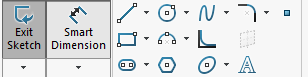
SolidWorks provides many solutions to achieve defined sketch-dimensions. In this tutorial, all dimensions will be done with Smart Dimension located in the Command Manager Hot bar.

Figure 2: Command Manager

BASIC APPROACH

Dimensioning sketches in SolidWorks is made simple with auto-scaling. The developers of SolidWorks programed auto-scaling based on the initial dimension added to the sketch. First defining the overall shape and size of the sketch is the most efficient method when getting into larger models. Then working down until all the tiny tedious geometry of the sketch are fully defined are the next steps to properly defining a sketch. Using the left-side sketch shown in Figure 1 as the starting point, notice how all the lines are blue? These blue lines tell us that the sketch is underdefined and can be moved around with the click of a mouse.

Figure 3: Initial Sketch

Once the initial sketch is made as explained in Perception Engineering’s Sketches Blog, the first step is to define the overall size. After selecting Smart Dimension as shown in Figure 2, the arrow cursor will now have the Smart Dimension Icon under it. To define the overall; first, the width dimension needs to be set. Click on the large circle located on the origin of the sketch, the Dimension Modify popup will prompt the user to set the radius of the circle.

Figure 4: Dimension Modify Popup

Now that the width is set, the length of the sketch needs to be defined before moving onto the smaller pieces of geometry that makes up the part.

Figure 5: Setting the Length

One trick of Smart-Dimensioning in SolidWorks is the “Shift” key on the Keyboard. Holding the “Shift” key and selecting the outer most part of the circle and again while holding “Shift” selecting the other outer most edge of the sketch will grab the overall length of the sketch as shown in Figure 5.

DIMENSION SPACING

Once the overall dimensions are in place, the sketch will auto scale accordingly to fit the same proportions of the previous geometry dimensioned. The nice thing about Smart-Dimensioning in SolidWorks is the feature identifier: dimensioning horizontally, vertically, angles or radii can all be done with the Smart-Dimension tool. As seen on the right-side sketch in Figure 1 and in the figure below, the sketches geometry is defined with radius dimensions and angle dimensions.

Figure 6: Dimension Spacing

Placing random dimensions all over the screen is not a good practice and can be rather confusing for anyone trying to work on the CAD model. Good practice is proper spacing and orientation of all dimensions within the sketch. Notice in Figure 6 how all the dimensions are nicely spaced and visible, this allows the designer to review the sketch without confusion. Due to the unlimited number of ways to properly define this sketch, it is essential to keep the sketch dimensions clean, clear, and to the point. Instead of using angle dimensions in Figure 6, the length and height of the line could be defined instead. Again, there are unlimited ways to define a sketch so having clean and clear dimensions of the sketch is important.

FULLY DEFINED SKETCH

The sketch is fully defined if the lines on the sketch are all black. This means that there can be no unexpected changes within the model due to all the geometry of the sketch being fully defined. On more complex sketches with 100+ lines, looking on the bottom right corner the SolidWorks interface will help tell the user if the sketch is fully defined.

Figure 7: Fully Defined

Having a sketch be fully defined is not only important for displaying all the key geometry of the sketch, but it allows for easier changes. Double-clicking on any dimension will prompt SolidWorks to bring back the Dimension Modify popup. Changing the overall length from 3.00” to 4.50” is as a few clicks away; however, if the model is not fully defined the sketch will change without warning and the geometry may unpredictably change.

Figure 8: Changing Dimensions

The team here at Perception Engineering is constantly refining our skills to be the most efficient engineering solution. The basic skill of properly defining a sketch carries over into ease of modeling massive multi-million-dollar machines. Most projects will require some changes and tweaks to the model, and if the sketches are not fully defined there might be some frustration due to the models moving out of control with each change.

That’s all for now! You now know how to properly define a sketch and make changes to existing geometry. If you like the content or have questions, signup for our email list to stay in the loop for solutions or weekly content.


Written By: